Blood Bank
- Flutter
- Dart
- TypeScript
- Node.js
- Fastify
- Zod
- SQLite
- Drizzle
- Venice AI
- Docker
- GitHub Actions
An app for blood donors: educational guide, donation history, the next date you can donate again, plus AI quizzes and a Q&A assistant. It started in 2023 as an undergraduate research project at FEMA and was rebuilt in 2026 as a monorepo with a Flutter app and a custom TypeScript API.
- Timeline
- 2023 → 2026
- Origin
- Undergraduate research · CEPEIN FEMA
- Platforms
- Android · iOS · Web
- Authors
- Matheus Saleh and Gabriel Eduardo de Souza
The problem
Blood donation is voluntary and depends on donors knowing whether they can give and when they can come back. The interval rules (60 days for men, 90 for women) and the yearly limit (4 and 3 donations) are not widely known, and wrong information keeps donors away.
The app brings reliable information, checked against Brazil's Ministry of Health, together with personal tracking: every recorded donation updates the estimate of the next date. The calculation is an educational estimate, and the app makes clear that the blood center's screening has the final say.
The 2023 version was part of the research paper “O uso de Dart e Flutter para desenvolvimento de jogos em aplicativos móveis” (in Portuguese), published in the proceedings of FEMA's Scientific Forum.
Screenshots
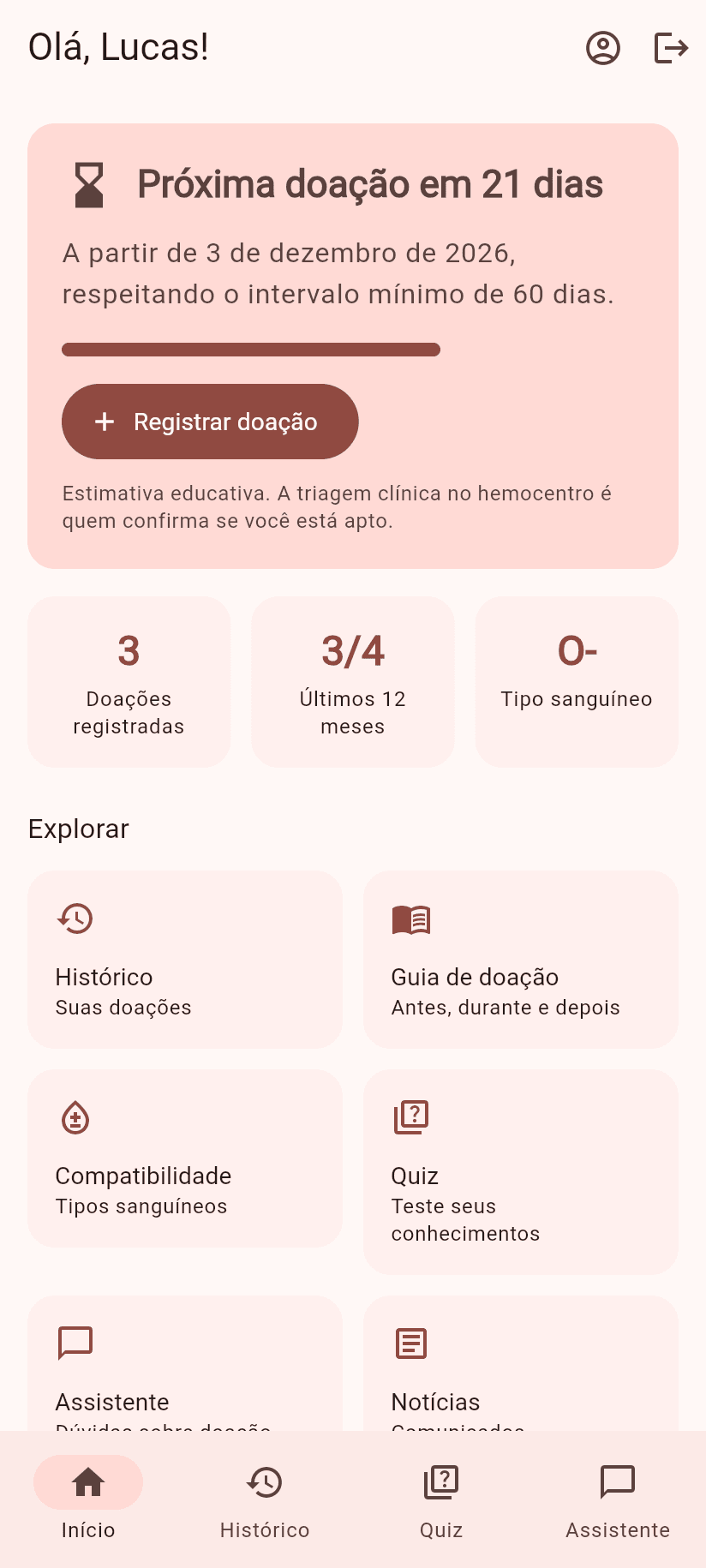
Screens from the real Web build in API mode, with a fictional donor and real Venice AI answers. The app UI is in Portuguese.
Artificial intelligence(6)
Quiz generated by Venice AI Explanation after each answer Quiz result Assistant with suggested questions Conversation that keeps context Daily AI quota used up
Donor tracking(7)
Home: days until the next donation and bottom navigation Donation history Recording a donation ABO/Rh red cell compatibility Before, during and after guide Local quiz, works without AI Sign-in against the custom API
Dark theme and wide screens(2)
Dark theme Responsive wide layout
Demo data: the donor Lucas Andrade is fictional and lives in a separate database. The capture environment's quota was lowered to 3 requests to show the block; the app default is 20 per day.
Features
What came from the 2023 version and what was built during the 2026 rebuild.
- 2026
Next eligible donation date
Calculated from the minimum interval and the donation limit over 12 months, based on the sex set in the profile.
- 2026
AI quizzes
Five questions per round, with shuffled topics and options and an explanation after each answer. Without AI, the local quiz still works.
- 2026
Q&A assistant
Chat about donating and blood banks that keeps context and suggests follow-up questions. Profile and history are not sent to the provider.
- 2026
Daily AI quota per account
20 requests a day, shared by quiz and chat, reserved atomically in SQLite and reset at midnight Brasília time.
- 2023 · 2026
Donation log and history
Built in 2023; in 2026 it gained editing, delete with “Undo” and date validation.
- 2023 · 2026
Guide and educational quiz
Tips for before, during and after donating, reviewed against the official source, and a quiz with explanations and a progress bar.
- 2026
ABO/Rh compatibility
Full red cell compatibility table, covered by tests.
- 2023 · 2026
Accounts and profile
Login built in 2023; sign-up, password reset and the donor profile (name, sex and blood type) in 2026.
- 2023 · 2026
News
Published by admins, with error states and loading that tolerates missing fields.
- 2026
Demo mode
Runs without a server: session, profile and donations stay in the device's local storage.
Architecture
A monorepo with the app and the API. The app talks to the API over HTTPS with a Bearer token; the AI key never leaves the server.
- Screens and view models with ChangeNotifier and provider
- Pure Dart domain: eligibility and compatibility rules
- Repositories with two implementations: local (demo) and API
- Token in secure storage (Keychain / Keystore)
- go_router with a single guard and StatefulShellRoute to keep all four tabs alive
- auth, donor, news and ai modules
- Zod validates input and output and generates the OpenAPI docs
- Drizzle ORM on SQLite with versioned SQL migrations
- Rate limiting, Helmet, scrypt passwords and hashed opaque tokens
- Venice AI integration and a persisted daily quota
Technical decisions
| Decision | Why | Trade-off |
|---|---|---|
| Custom API instead of Firebase | Full control of the rules, no dependency on a cloud project, testable locally | Running a server, database and email |
| Hashed opaque tokens (not JWT) | Instant revocation on logout and password change; a token leaked from the database is useless | One database query per request |
| Venice only on the backend | The key never ships in the APK or Web build; validation and limits live on the server | Needs connectivity, provider credit and handling of bad answers |
| Daily quota with atomic reservation | Prevents going over the limit with concurrent sessions, devices or processes | Every instance must share the same database |
| YYYY-MM-DD dates | Donation rules count days, not instants; avoids time zone bugs | One day of server tolerance for time zones ahead |
From 2023 to 2026
Original version · 2023
- Login with Firebase Authentication
- News and donations straight from Firestore
- Guide, 5-question quiz and About screen
- Firebase called from inside widgets
- Accounts could only be created in the Firebase console
- Only Flutter's default test, which failed
Rebuild · 2026
- Flutter 3.50 with MVVM architecture and go_router
- Custom Fastify + SQLite API replacing Firebase
- Sign-up, password reset and revocable sessions
- AI quiz and assistant with a daily quota per account
- Content reviewed against the Ministry of Health
- 145 tests and CI on GitHub Actions
Quality
- API tests
- 71
- app tests
- 74
- Node versions in CI (22 and 24)
- 2
Tests cover isolation between users, session expiry and revocation, rate limiting, password reset, eligibility rules with leap years, the full ABO/Rh table, a mocked Venice integration and the daily quota under cross-process concurrency. CI runs lint, typecheck, tests, build and audit for the API, builds the Docker image, and produces the app's Web build and APK.
Limitations and next steps
- Password reset still needs an email provider; today the code is printed in the API log.
- The 2023 data stayed in the original project's Firestore and was not migrated.
- The iOS build was not produced, since it requires macOS.
- Next steps: a reminder when the donation date arrives, PostgreSQL in production and a map of blood centers from official data.
Want to see the code?
The repository has the app, the API, the tests and the script that generates these screenshots. Built by Matheus Saleh and Gabriel Eduardo de Souza.